Best Theme Parks in Europe, Ranked
Compare the European theme parks in our global top 50, ranked by the same overall score for thrills, family appeal, value and waits. Regional position is separate from worldwide rank; choose a park around your group's priorities, not its position alone.
Europa-Park leads our European ranking with an overall score of 9.5/10.
- 1. Europa-ParkGermany · 9.5/10
- 2. EftelingNetherlands · 9.0/10
- 3. PhantasialandGermany · 8.3/10
Top 3 in this ranking
 Rust, Baden-Württemberg, Germany
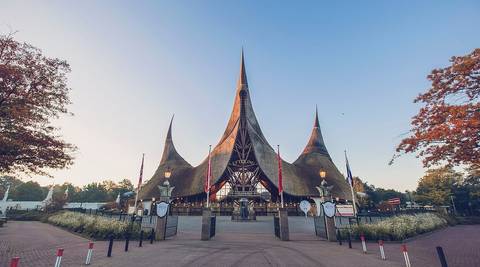
 Kaatsheuvel, Netherlands
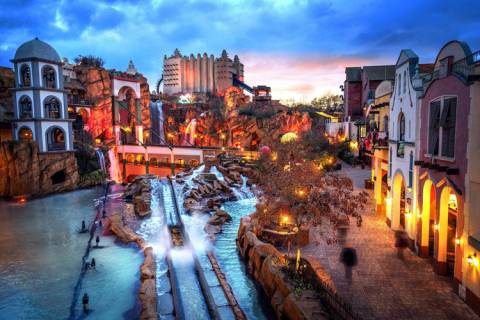
The European ranking
Positions below are the parks' places within Europe. Each park's global rank across all 50 is shown alongside its score out of 10. Plan a trip to these parks
- 1
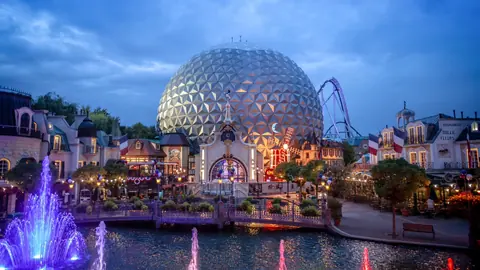 Europa-Park Germany#1 worldwide100 rides€67–839.5
- 2
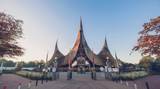 Efteling Netherlands#2 worldwide32 rides€40–569.0
- 3
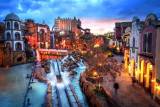 Phantasialand Germany#9 worldwide19 rides€38–788.3
- 4
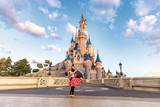 Disneyland Park (Paris) France#14 worldwide40 rides€62–1107.8
- 5
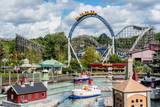 Liseberg Sweden#15 worldwide42 rideskr 365– 6257.8
- 6
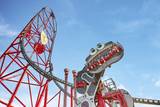 PortAventura Park Spain#18 worldwide40 rides€39–657.7
- 7
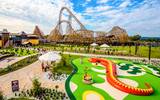 Energylandia Poland#20 worldwide72 rideszł 219– 2297.6
- 8
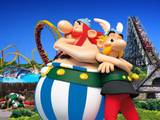 Parc Astérix France#21 worldwide40 rides€49–687.6
- 9
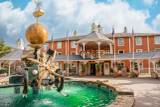 Alton Towers United Kingdom#23 worldwide40 rides£34–687.5
- 10
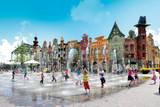 Plopsaland De Panne Belgium#27 worldwide55 rides€38–547.4
- 11
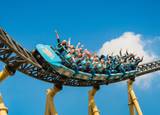 Heide Park Resort Germany#28 worldwide30 rides€37–647.3
- 12
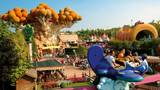 Gardaland Italy#29 worldwide40 rides€54–647.2
- 13
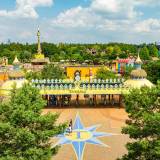 Toverland Netherlands#36 worldwide40 rides€38–597.0
- 14
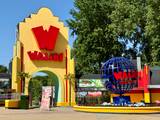 Walibi Holland Netherlands#38 worldwide40 rides€30–467.0
- 15
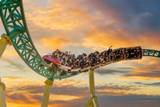 Thorpe Park United Kingdom#40 worldwide25 rides£32–666.9
- 16
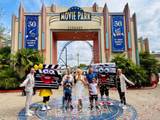 Movie Park Germany Germany#46 worldwide40 rides€30–606.5
- 17
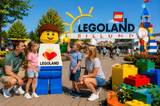 Legoland Billund Resort Denmark#49 worldwide45 rideskr 379– 5396.1
- 18
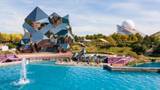 Futuroscope France#50 worldwide40 rides€47–566.0
 France
 Sweden
 Spain
 Poland
 United Kingdom
 Belgium
 Italy
 Denmark
A continent of theme-park traditions, not one style
Ask what a 'European theme park' looks like and the honest answer is that there isn't one template. Rust, near the French-German-Swiss border, hosts Europa-Park, organized as a procession of national-style zones, from an Italian piazza to a Portuguese-styled quarter, with coasters including Silver Star and Voltron Nevera, powered by Rimac woven into the theming. Farther north in Brühl, Phantasialand compresses its site into tightly packed, heavily immersive lands such as Klugheim and Rookburgh, where the launch coaster Taron and the flying coaster F.L.Y. are inseparable from their surroundings. Neither approach is the European default; they are two answers to the same design problem.
Move north and the character shifts again. Efteling, near Kaatsheuvel in the Netherlands, grew out of a fairy-tale forest walk and still leads with storytelling attractions like the dark ride Symbolica rather than record-chasing steel. Alton Towers and Thorpe Park, England's two comparable entries, sit on opposite ends of a spectrum: Alton Towers pairs its wooded Staffordshire estate with coasters like Nemesis and the wooden Wicker Man, while Thorpe Park in Surrey leans harder into intensity with Hyperia, currently Britain's tallest and fastest coaster. France adds a further contrast: Disneyland Paris operates two gated parks on one site east of Paris, while Parc Astérix, north of the capital, builds its identity around Gaulish folklore with rides such as Toutatis.
What really separates a visit to one of these parks from another is less the headline coaster than the rhythm of the day. Efteling and Europa-Park are destinations people stay near for two or three days, with hotels built into the plan; Thorpe Park and Parc Astérix are more commonly single-day add-ons to a city stay in London or Paris. That distinction matters more for planning than any comparison of ride counts, since it changes whether you are booking a resort break or a day ticket squeezed between other plans.
Season length varies by climate and business model as much as by country. Alton Towers runs its main theme park roughly from March to early November before a shorter festive operation, a pattern common to UK and French seasonal parks. Efteling offers year-round visits, while Europa-Park has a dedicated winter season with its own operating dates, turning what would be a dead season elsewhere into a selling point. None of this is a reason to assume a park is open or closed on a given date; check the operator's live calendar before booking travel, since hours and ride operation shift with weather and demand.
Cost is similarly driven by factors that have nothing to do with a park's quality. Dynamic, date-based pricing is now standard at the larger resorts, so the same gate ticket can cost noticeably more on a weekend in August than a weekday in November; multi-day and resort-hotel packages change the comparison again. Rather than quote a figure that will be outdated by the next pricing update, check each park's own ticket page for your travel date, since that is the only source reflecting current, dated pricing.
None of this adds up to a single best country for a theme-park trip. A visitor chasing steel coasters, a family wanting a gentle multi-day break, and a city traveler squeezing in one big day will reasonably end up in three different countries, sometimes three different parks in the same country. Reading the specific attractions and the practical calendar is a better starting point than treating 'Europe' as one itinerary.
Official planning sources: Europa-Park – all attractions · Phantasialand – Taron · Efteling – Symbolica: Palace of Fantasy · Alton Towers – opening times
Frequently asked questions
- What is the best theme park in Europe?
- The park at position 1 below currently tops the European ranking. It leads on the combined score of thrill intensity, family appeal, ticket value and crowd management.
- How are European theme parks ranked?
- Scores come from public review platforms and published park data, weighted across thrill, family appeal, value and wait times.
- Which European countries have the most ranked parks?
- Germany, France, the Netherlands, the UK, Spain, Belgium, Sweden, Denmark, Italy and Poland all place at least one park in the global top 50.